RTO vs RCO: What Is the Difference Between a Regenerative Thermal Oxidizer and a Regenerative Catalytic Oxidizer?
Industrial facilities generating volatile organic compounds (VOCs) and hazardous air pollutants (HAPs) rely on oxidizers to destroy these emissions before release. Two popular technologies are the Regenerative Thermal Oxidizer (RTO) and the Catalytic Oxidizer (often a Regenerative Catalytic Oxidizer or RCO). While both achieve high destruction efficiencies (typically 95–99%), they differ significantly in operation, efficiency, and suitability.
How They Work
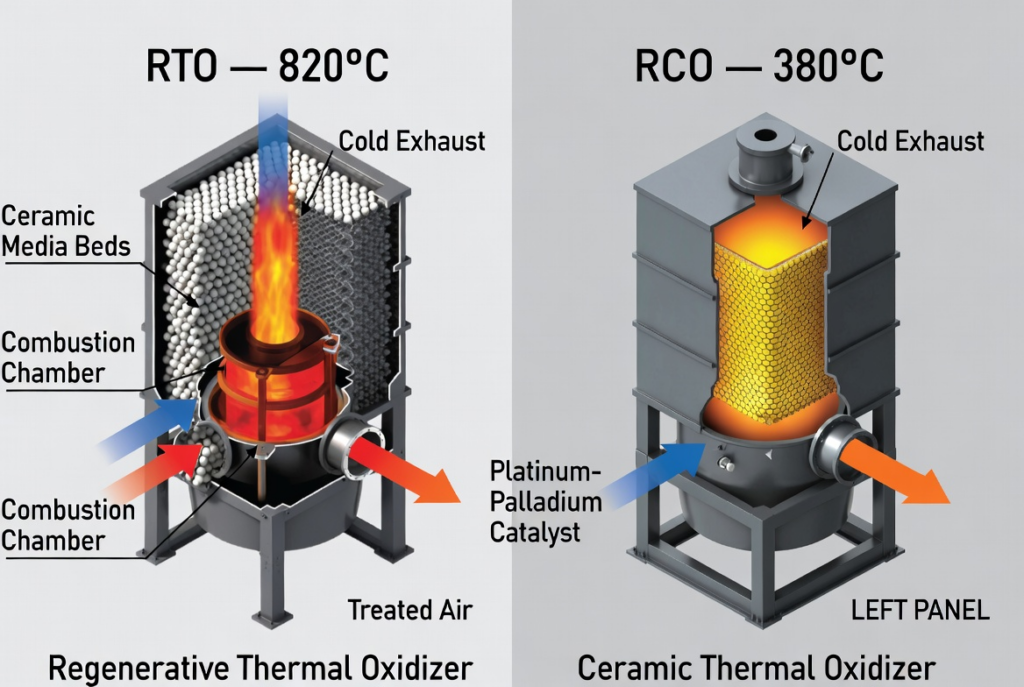
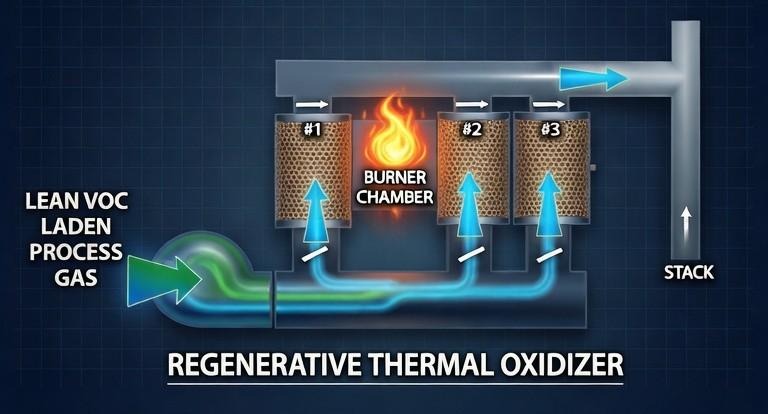
Regenerative Thermal Oxidizer (RTO): RTOs destroy pollutants through high-temperature thermal oxidation. Process exhaust passes through ceramic heat recovery beds that preheat the air. A combustion chamber then heats it to 760–980°C (1400–1800°F) for oxidation into CO₂ and water. The system alternates flow direction to recover up to 95–97% of the heat, making it highly energy-efficient for large volumes and low-to-moderate VOC loads.
Catalytic Oxidizer (CATOX or RCO): These use a precious-metal catalyst (e.g., platinum or palladium) to lower the activation energy, enabling oxidation at much lower temperatures — typically 300–500°C (570–930°F). Many incorporate regenerative ceramic beds for heat recovery, similar to RTOs. This reduces fuel consumption significantly while maintaining high destruction rates.
Key Differences
| Aspect | RTO | Catalytic Oxidizer (RCO) |
|---|---|---|
| Operating Temp. | 1400 – 1800 °F | 570 – 930 °F |
| Energy/Fuel Use | High thermal efficiency; good for low VOCs | Even lower fuel use due to catalyst |
| Capital Cost | Higher (larger equipment) | Generally lower |
| Operating Cost | Low for high-volume, steady processes | Often lowest overall |
| Maintenance | Valves/dampers; durable ceramics | Catalyst replacement/poisoning or plugging risk |
| Best For | High airflow, low VOC loads, somewhat particulates-tolerant | Cleaner streams, moderate VOCs, energy-sensitive ops |
| Limitations | Higher temps = more NOx potential | Catalyst sensitive to poisons/silicones |
When to Choose Which?
- Choose an RTO for large-scale operations with high exhaust volumes, potential low particulates, or low halogenated compounds. Its robustness and heat recovery shine in continuous, large applications.
- Choose a Catalytic Oxidizer when minimizing energy use (fuel) and emissions is critical, or for facilities with cleaner, lower-volume streams. Lower temperatures mean less stress on materials and potentially electric heating options.
Both systems deliver excellent environmental compliance, but the right choice depends on your process conditions, flow rate, VOC profile, and total cost of ownership. Consult an emissions control specialist for a site-specific analysis.
Need help evaluating oxidizer options for your facility? Drop a comment or reach out!